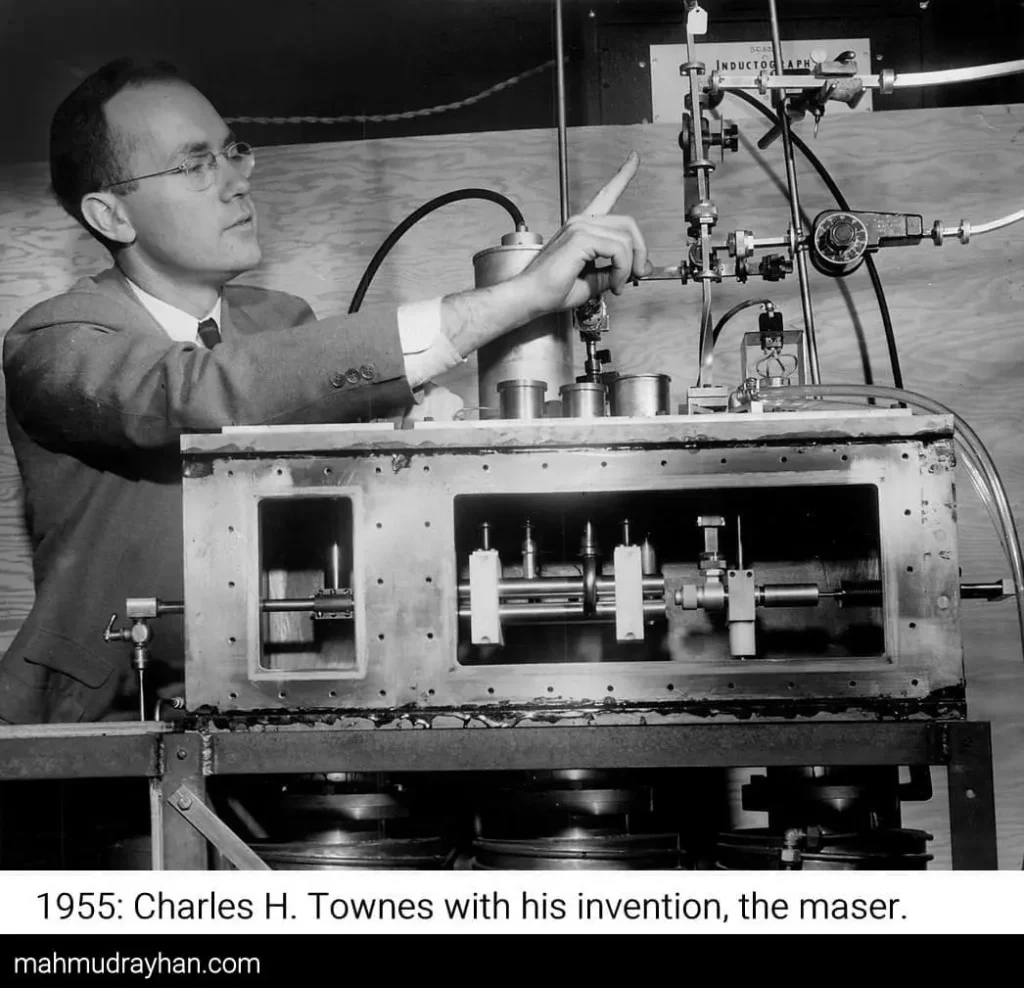
In 1951 Charles H. Townes sat on a park bench and came up with the theory that would lead to the laser.
He won the Nobel Prize for the fundamental work in the field of quantum electronics, which has led to the construction of oscillators and amplifiers based on the maser-laser principle.
Charles Hard Townes was born in Greenville, South Carolina, on July 28, 1915, the son of Henry Keith Townes, an attorney, and Ellen (Hard) Townes. He attended the Greenville public schools and then Furman University in Greenville, where he completed the requirements for the Bachelor of Science degree in Physics and the Bachelor of Arts degree in Modern Languages, graduating summa cum laude in 1935, at the age of 19.
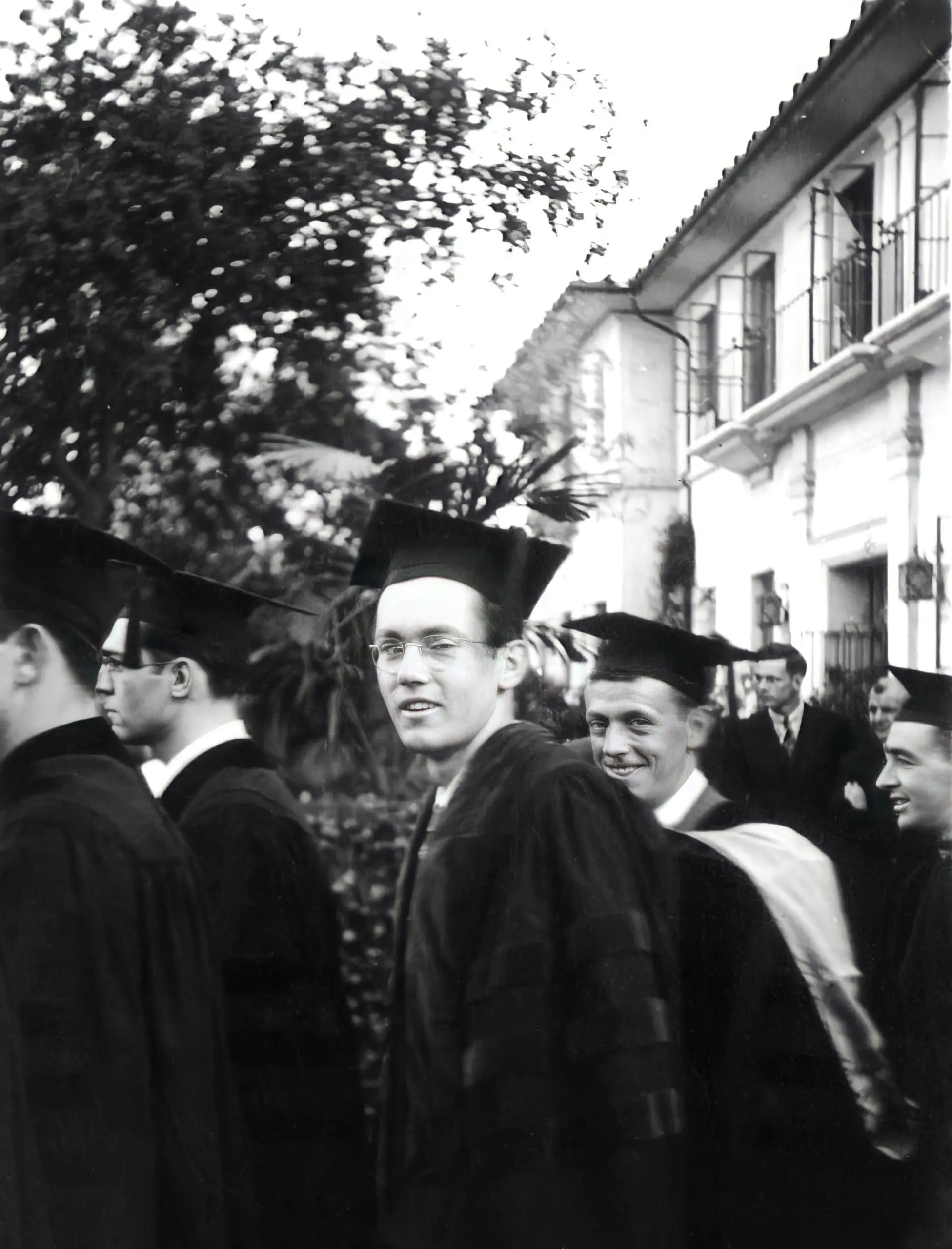
Physics had fascinated him since his first course in the subject during his sophomore year in college because of its “beautifully logical structure”. He was also interested in natural history while at Furman, serving as curator of the museum, and working during the summers as collector for Furman’s biology camp. In addition, he was busy with other activities, including the swimming team, the college newspaper and the football band.
Townes completed work for the Master of Arts degree in Physics at Duke University in 1936, and then entered graduate school at the California Institute of Technology, where he received the Ph.D. degree in 1939 with a thesis on isotope separation and nuclear spins.
A member of the technical staff of Bell Telephone Laboratories from 1933 to 1947, Dr. Townes worked extensively during World War II in designing radar bombing systems and has a number of patents in related technology. From this he turned his attention to applying the microwave technique of wartime radar research to spectroscopy, which he foresaw as providing a powerful new tool for the study of the structure of atoms and molecules and as a potential new basis for controlling electromagnetic waves.
At Columbia University, where he was appointed to the faculty in 1948, he continued research in microwave physics, particularly studying the interactions between microwaves and molecules, and using microwave spectra for the study of the structure of molecules, atoms, and nuclei. In 1951, Dr. Townes conceived the idea of the maser, and a few months later he and his associates began working on a device using ammonia gas as the active medium.
In early 1954, the first amplification and generation of electromagnetic waves by stimulated emission were obtained. Dr. Townes and his students coined the word “maser” for this device, which is an acronym for microwave amplification by stimulated emission of radiation. In 1958, Dr. Townes and his brother-in-law, Dr. A.L. Schawlow, for some time a professor at Stanford University but now deceased, showed theoretically that masers could be made to operate in the optical and infrared region and proposed how this could be accomplished in particular systems.
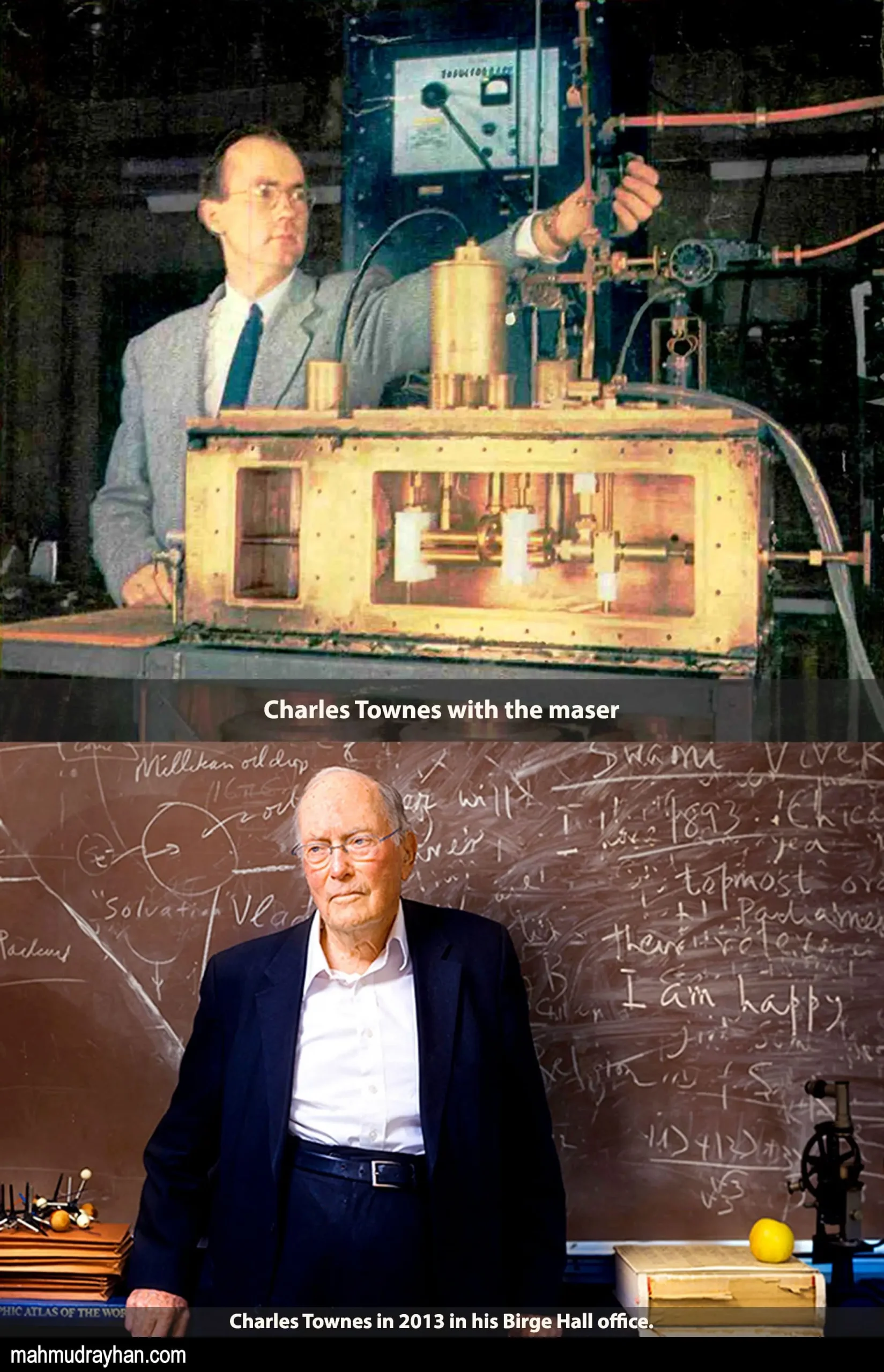
This work resulted in their joint paper on optical and infrared masers, or lasers (light amplification by stimulated emission of radiation). Other research has been in the fields of nonlinear optics, radio astronomy, and infrared astronomy. He and his assistants detected the first complex molecules in interstellar space and first measured the mass of the black hole in the center of our galaxy.
Having joined the faculty at Columbia University as Associate Professor of Physics in 1948, Townes was appointed Professor in 1950. He served as Executive Director of the Columbia Radiation Laboratory from 1950 to 1952 and was Chairman of the Physics Department from 1952 to 1955.
From 1959 to 1961, he was on leave of absence from Columbia University to serve as Vice President and Director of Research of the Institute for Defense Analyses in Washington, D.C., a nonprofit organization which advised the U.S. government and was operated by eleven universities.
In 1961, Dr. Townes was appointed Provost and Professor of Physics at the Massachusetts Institute of Technology. As Provost he shared with the President responsibility for general supervision of the educational and research programs of the Institute.
In 1966, he became Institute Professor at M.I.T., and later in the same year resigned from the position of Provost in order to return to more intensive research, particularly in the fields of quantum electronics and astronomy. He was appointed University Professor at the University of California in 1967. In this position Dr. Townes is participating in teaching, research, and other activities on several campuses of the University, although he is located at the Berkeley campus.
During 1955 and 1956, Townes was a Guggenheim Fellow and a Fulbright Lecturer, first at the University of Paris and then at the University of Tokyo. He was National Lecturer for Sigma Xi and also taught during summer sessions at the University of Michigan and at the Enrico Fermi International School of Physics in Italy, serving as Director for a session in 1963 on coherent light. In the fall of 1963, he was Scott Lecture at the University of Toronto. More recently (2002-2003) he has been the Karl Schwarzschild Lecturer in Germany and the Birla Lecturer and Schroedinger Lecturer in India.
In addition to the Nobel Prize, Townes has received the Templeton Prize, for contributions to the understanding of religion, and a number of other prizes as well as 27 honorary degrees from various universities.
Throughout his life, Townes maintained an interest in the intersection of science and religion. His seminal 1966 article, “The Convergence of Science and Religion,” established him as a unique voice – among scientists, in particular – seeking commonality between the two disciplines.
“My own view is that, while science and religion may seem different, they have many similarities, and should interact and enlighten each other,” Townes wrote in a statement upon accepting the 2005 Templeton Prize.
“Science tries to understand what our universe is like and how it works, including us humans,” he wrote. “Religion is aimed at understanding the purpose and meaning of our universe, including our own lives. If the universe has a purpose or meaning, this must be reflected in its structure and functioning, and hence in science.”
Townes was a member of the National Academy of Sciences, National Inventors Hall of Fame, South Carolina Hall of Fame and Engineering and Science Hall of Fame. He received honorary degrees from 25 colleges and universities and numerous honors, including the National Medal of Science, National Academy of Sciences’ Comstock Prize and the John J. Carty Medal, Rumford Premium of the American Academy of Arts and Sciences, Stuart Ballentine Medal of the Franklin Institute (twice), the C.E.K. Mees Medal of the Optical Society of America, the Medal of Honor of the Institute of Electrical and Electronics Engineers, Plyler Prize of the American Physical Society, NASA’s Distinguished Public Service Medal, Thomas Young Medal and Prize of the Institute of Physics and the Physical Society (England), Wilhelm Exner Award (Austria) and the 1979 Niels Bohr International Gold Medal.
He also was a member and former president of the American Physical Society, a member of the American Academy of Arts and Sciences and the National Academy of Engineering, and a foreign member of the Royal Society and the Russian Academy of Sciences. A member of the American Astronomical Society, in 1998 he was awarded the society’s Henry Norris Russell Lectureship for a lifetime of eminence in astronomical research.
In 1941, Charles Townes married Frances Brown. The couple enjoyed a marriage lasting more than six decades. They raised four daughters and enjoyed a lifetime of travel and outdoor activities, including mountain climbing. In his ninth decade, Charles Townes was still traveling the world, discussing the future of science. He told the story of his life and accomplishments in two books, Making Waves (1995) and How the Laser Happened: Adventures of a Scientist (2000). Mrs. Townes told her side of the story in a book of her own, Misadventures of a Scientist’s Wife (2007). Charles Townes spent his last years in Berkeley, where he was Professor Emeritus at the University of California.
Professor Townes left us on 7 January 2015, Berkeley, CA, USA.
For more info read through – MIT Publication
Archive Credit: UC Berkeley